Understanding Prostate Enlargement: Causes, Symptoms, and What Men Are Doing About It
A straightforward guide to benign prostatic hyperplasia — the condition affecting millions of men over 50, and why standard approaches often fall short
8 min readReviewed for accuracy
The Condition
What Is Benign Prostatic Hyperplasia (BPH)?
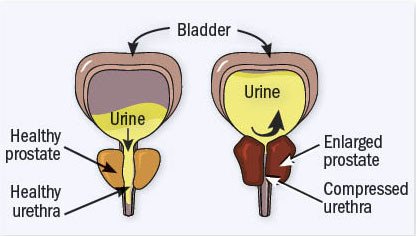
Figure 1. Left: healthy prostate with normal urine flow through an open urethra. Right: enlarged prostate compressing the urethra, restricting urine flow and increasing bladder pressure.
The prostate is a small gland, roughly the size of a walnut, located just below the bladder. Its primary function is to produce fluid that nourishes and transports sperm. For most of a man's life, it stays small and causes no problems.
Benign prostatic hyperplasia — commonly known as an enlarged prostate — occurs when the prostate gland gradually increases in size and begins to press against the urethra, the tube that carries urine out of the body. This pressure is what causes the familiar and often distressing urinary symptoms that affect tens of millions of men worldwide.
The word "benign" is important: BPH is not cancer and does not increase the risk of prostate cancer. However, left unaddressed, it can lead to serious complications including urinary tract infections, bladder stones, and in severe cases, kidney damage.
50%
of men ages 51–60 are affected by BPH
90%
of men over 80 have some degree of prostate enlargement
44%
of Americans have water quality issues linked to mineral contamination
Recognizing the Signs
Common Symptoms of an Enlarged Prostate
Symptoms range from mildly inconvenient to severely disruptive. Because they develop gradually over months or years, many men normalize them — attributing broken sleep and bathroom urgency to "just getting older." Recognizing them is the first step toward addressing them.
Weak or interrupted urine stream
Waking multiple times per night to urinate
Difficulty starting urination
Feeling of incomplete bladder emptying
Dribbling after urinating
Sudden, urgent need to urinate
Recurrent urinary tract infections
Decreased libido and sexual function
Important
These symptoms can also be associated with other conditions, including prostate cancer, bladder infections, and kidney disease. Any man experiencing persistent urinary symptoms should consult a qualified healthcare provider for a proper evaluation before pursuing any course of action.
Discover the Natural Approach That Over 185,000 Men Have Already Tried
A board-certified urologist from the University of Louisville explains the overlooked cause behind prostate enlargement — and the specific natural protocol he now recommends to his patients.
Why Does the Prostate Enlarge — And What Is Actually Behind It?
For decades, the standard explanation for BPH has been age-related hormonal shifts — particularly changes in testosterone and estrogen levels. While these play a role, this explanation leaves a critical question unanswered: why do some men develop severe BPH in their 40s while others remain relatively unaffected well into their 80s?
Newer independent research, including data cited by Harvard Medical School, has pointed toward a different factor: the mineral content of drinking water. Specifically, the microscopic calcium carbonate particles found in hard water — which is present in some form across the majority of the United States — may accumulate over time in the urinary tract, contributing to inflammation and prostate growth.
Studies mapping BPH incidence rates across the country show notable correlations with regional water hardness levels. The theory is that the body's natural response to this mineral buildup — frequent urination as an attempt to flush the deposits — is itself a core driver of the progressive symptoms men experience.
Research Context
Repairing and replacing America's aging water infrastructure is estimated to cost approximately $1 trillion and would take around 200 years under current projections, according to water infrastructure experts. In the meantime, personal approaches to managing mineral intake and supporting the body's natural elimination processes have become an area of increasing focus for researchers and clinicians.
Natural Support
Natural Compounds Studied for Prostate Health
A growing body of research has examined specific natural compounds for their potential to support urinary tract health and address the underlying factors linked to prostate enlargement. The following ingredients have been studied in peer-reviewed clinical settings.
Epidemiological studies have found associations between high iodine intake — particularly from seaweed-rich diets as seen in Japan — and significantly lower rates of BPH. In Japan, only 12% of men are affected by prostate enlargement compared to 80% in the United States. Iodine is rapidly excreted through urine, passing through the prostate and urinary tract along the way. Bladderwrack in particular has been studied for its ability to reduce PSA levels and support prostate tissue health.
🌿
Saw Palmetto
One of the most well-researched natural compounds for prostate health, saw palmetto is incorporated into 90% of BPH-related herbal formulas in Germany and 50% in Italy. Multiple clinical trials have demonstrated improvements in urinary flow rates and reductions in BPH-associated symptoms. It works in part by blocking 5-alpha reductase, an enzyme associated with prostate cell proliferation.
⛰️
Shilajit
A mineral-dense resinous compound found in the Himalayas, Shilajit contains over 84 trace minerals and has been studied for its effects on prostate enlargement, testosterone levels, and urinary health. One study showed measurable inhibition of prostate tissue growth after just 15 days of use. It has also demonstrated positive effects on sperm motility, testosterone production, and energy levels.
🌳
Pygeum Africanum
Derived from African cherry tree bark, Pygeum contains phytosterols that research suggests may help reduce prostate tissue inflammation and inhibit excess growth. It is widely used in clinical settings across Europe for BPH management and has been studied alongside seaweed-derived iodine compounds for enhanced effect.
🍈
Pomegranate Extract
Studies have found pomegranate extract can increase testosterone levels by up to 25% within two weeks of consistent use. It also supports nitric oxide production — important for healthy blood flow and sexual function — while reducing estrogen levels. Its antioxidant profile makes it a useful addition to prostate-focused nutritional protocols.
See How These Natural Ingredients Are Being Combined Into a Single Protocol
A urologist explains the specific formulation his team developed after years of research — and how it targets the mineral buildup believed to drive prostate enlargement.
Plant-based, non-habit-forming, no prescription needed
No registration required. Individual results may vary.
Frequently Asked Questions
Questions Men Ask Most About Prostate Health
Benign prostatic hyperplasia, commonly known as an enlarged prostate, is a non-cancerous condition in which the prostate gland gradually increases in size. As it grows, it can press against the urethra and interfere with normal urinary function. BPH is one of the most common conditions affecting men over the age of 50.
The most common symptoms include a weak or interrupted urine stream, frequent urination especially at night, difficulty starting urination, a feeling that the bladder never fully empties, dribbling after urinating, and in more advanced cases, urinary incontinence or recurrent urinary tract infections.
While BPH becomes increasingly common with age, researchers now suggest that aging alone does not fully explain why some men develop severe symptoms while others do not. Environmental and dietary factors — including the mineral content in drinking water — are being actively studied as contributing causes.
Emerging research has explored a potential link between hard water — water high in dissolved minerals such as calcium carbonate — and higher rates of prostate enlargement in certain geographic regions. Harvard Medical School has published data examining regional correlations between water hardness and BPH incidence rates. The hypothesis is that long-term accumulation of these mineral deposits in the urinary tract may contribute to prostate inflammation and growth.
Several natural compounds have been studied for their potential to support prostate health. Saw palmetto is used in 90% of BPH-related herbal formulas in Germany. Iodine-rich seaweeds such as bladderwrack, kelp, and wakame have demonstrated anti-inflammatory properties. Pygeum africanum bark extract and Shilajit have also been studied for their effects on prostate size and urinary flow. Pomegranate extract has shown benefits for testosterone and nitric oxide levels in clinical settings.
Yes. Reducing caffeine and alcohol intake, limiting fluids in the evening, maintaining a healthy weight, and regular physical activity can help manage mild to moderate symptoms. However, lifestyle adjustments alone are rarely sufficient for men with moderate to severe BPH, and a more targeted approach is generally recommended.
Any man experiencing persistent urinary symptoms — especially frequent nighttime urination, weak flow, straining, or a feeling of incomplete emptying — should consult a urologist. Early evaluation is important to rule out more serious conditions such as prostate cancer, urinary tract infections, or bladder dysfunction, and to prevent long-term complications including kidney damage.
Ready to Learn More About the Natural Approach to Prostate Health?
This free video presentation walks through the research, the specific natural ingredients involved, and what men who have already used this approach are reporting.
Natural, non-invasive — no surgery, no prescription required